


Stay Stable. Stay Alert. August Allied Safety News

YOUR PARTNER IN WORKPLACE SAFETY

MONTHLY MUSTER
Aerial & Scissor Lift Safety
Walk any active site this time of year and you'll see them everywhere — scissor lifts on the interior fit-out, boom lifts reaching a roofline, cherry pickers on the utility work. They get people up high quickly and safely when used correctly. When they're not, the failures tend to be catastrophic: a tip-over, a fall, a contact with a power line. These aren't slow-developing hazards. They happen in seconds.
SAME JOB, TWO DIFFERENT RULEBOOKS
Here's where a lot of confusion starts. "Aerial lift" and "scissor lift" get used interchangeably on the job, but OSHA treats them differently. Scissor lifts move the platform straight up and down on crossed beams and are regulated as mobile supported scaffolds — under the scaffold standards at 1926.451 and 1926.452(w).
True aerial lifts — boom lifts, bucket trucks, articulating and extensible platforms — fall under the aerial lift standard at 1926.453, which references the ANSI A92.2 definition. The practical difference that matters most: on a boom or bucket lift, workers generally must wear a body harness with a lanyard tied off to the manufacturer's anchor point. On a scissor lift with a properly maintained guardrail system in place, OSHA does not generally require an additional personal fall arrest system. Either way, the training requirements under 1926.454 apply to both scissor lifts and aerial lifts. Occupational Safety and Health Administration + 4
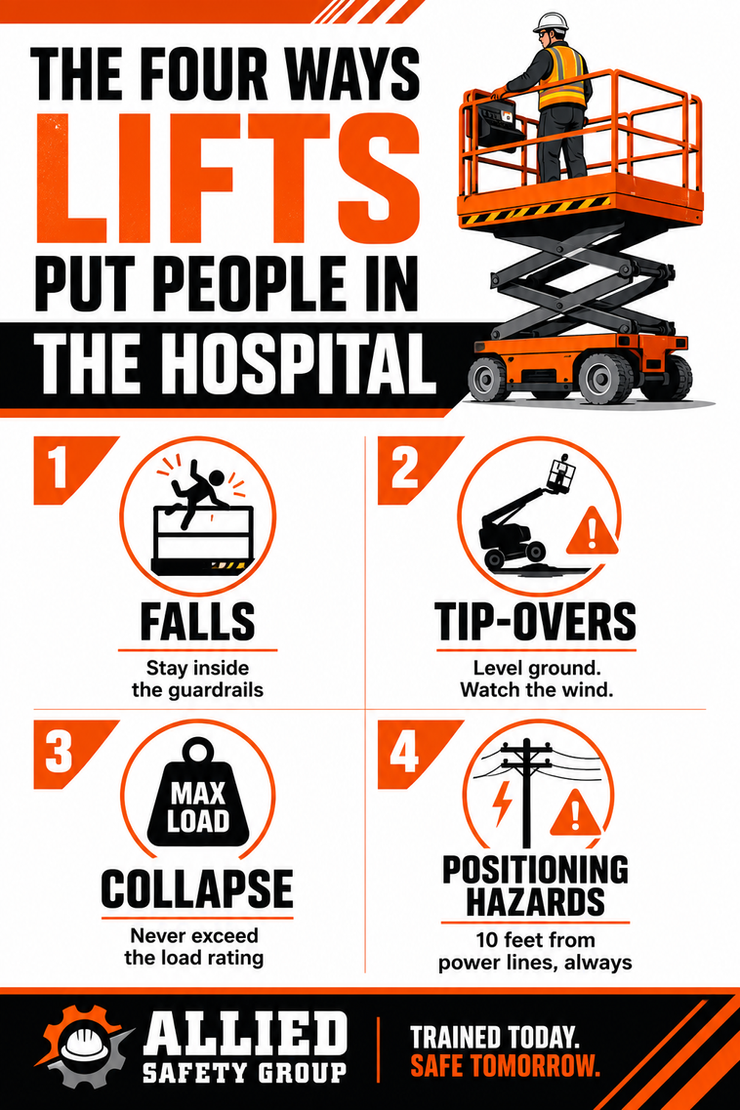
THE FOUR WAYS LIFTS PUT PEOPLE IN THE HOSPITAL
Falls
Guardrails must be in place before anyone works from the platform. Workers should stand only on the platform floor — never on the guardrails — and keep their work within easy reach instead of leaning out. Occupational Safety and Health Administration
Tip-overs and instability
This is the one that kills. A firm, level surface away from drop-offs, holes, slopes, and debris is essential, and the lift generally should not be moved while elevated. Wind is a silent factor: scissor lifts rated for outdoor use are generally limited to wind speeds below 28 miles per hour. OSHA's own case makes the point better than any statistic — during the 2010 college football season, an untrained worker filming a practice raised a scissor lift over 39 feet on a day with wind gusts above 50 mph; the lift blew over and he was killed. Occupational Safety and Health Administration + 2
Collapse.
Rare, but preventable. Never exceed the manufacturer's load rating, never bypass the safety systems, and never use other equipment (like a forklift) to raise the platform. Occupational Safety and Health Administration
Positioning — crushing and electrocution.
Keep at least 10 feet from power lines; electricity can arc to the lift or the worker even without direct contact. Use ground guides and traffic controls so a moving lift, vehicle, or fixed object like a doorframe or beam can't crush someone. Occupational Safety and Health Administration Occupational Safety and Health Administration
TRAINING THAT ACTUALLY HOLDS UP
Only trained workers should operate these lifts, and the employer has to make sure each operator can actually demonstrate they can run it properly — not just sit through a class. That means correct operating procedures per the manufacturer, safe material handling and weight limits, and awareness of other site hazards like overhead wires — plus a pre-use check of controls, guardrails, and brakes before every shift. Occupational Safety and Health Administration Occupational Safety and Health Administration
The bottom line: the platform you're using decides the rules you follow. Get that right, keep the ground stable, and train your operators to prove they're ready — and a lift stays what it's supposed to be: a tool, not a risk.
Add a paragraph. Click here to add your own text and edit me.
Tool Box Talk (5–10 minutes)
KNOW YOUR LIFT — STAY STABLE, STAY ALERT
Introduction (read aloud to your crew): Lifts make our work faster and safer — but only when they're set up and run right. A tip-over or a brush with a power line doesn't give you a second chance. Today we're covering how to keep both feet on solid footing, up in the air and down below.
Key Points:
Know what you're standing on. A scissor lift and a boom lift follow different rules. On a boom or bucket lift, wear your harness and tie off to the anchor point. On a scissor lift, make sure the guardrails are all in place before you climb on.
Set up on solid, level ground. No drop-offs, holes, slopes, or soft spots. If the surface isn't right, move the lift — don't risk it.
Watch the wind. Most scissor lifts rated for outdoor use shouldn't be run above about 28 mph of wind. If it's gusting, come down. A lift raised high in high wind can blow right over — it has killed workers doing exactly that.
Don't move it elevated, and don't overload it. Follow the manufacturer's rules on movement. Never put more weight on the platform than it's rated for, and never use anything but the lift itself to raise the platform.
Stay clear of power lines — 10 feet minimum. Electricity can jump the gap. You don't have to touch a line to be electrocuted.
Feet on the platform, not the rails. Keep your work within reach instead of leaning out over the edge.
Look out below. Crushing hazards hit the people around the lift too. Use a ground guide when moving it, and watch for doorframes, beams, and other equipment.
Discussion Questions:
On this site, what's the biggest lift hazard we deal with — unstable ground, tight overhead clearance, power lines, or traffic around the lift?
If someone's lift started to tip or lost power up high, does everyone here know the emergency lowering procedure and who to call?
Today's Action Items:
Before the next lift goes up, do a pre-use check together: controls, guardrails, brakes, and load rating.
Confirm every operator on this crew has been trained on the specific type of lift they're running today.
Identify all overhead hazards and power lines in today's work area and mark the 10-foot no-go zones.


Spotlight: Online Safety Training Through Our Learning Management System
Did you know Allied Safety Group offers online safety training through our Learning Management System (LMS)?
Our cloud-based LMS allows employees to complete training from any location with an internet connection — whether in the office, at home, or on the go. It's a practical solution for busy teams who can't always stop work for a full training day.
The platform hosts a variety of courses including safety training, equipment operation, leadership and supervisor development, and driver safety programs. It also includes automated course assignments, real-time reporting on completion rates, and a certificate generator so employees have documentation of their training on hand.
Whether you're onboarding new hires, meeting compliance requirements, or building out your team's skills, the LMS is a flexible, scalable option to support your safety program year-round.
Browse available courses or log in to your account at www.alliedsafetygroupllc.com, or contact us to learn more: 309.339.8950 | info@alliedsafety.org

Important Dates & Reminders
August 10–16: Safe + Sound Week. This is OSHA's nationwide event held every August to recognize the successes of workplace safety and health programs and share ideas for keeping workers safe. The 2026 event runs August 10–16, with a focus on safety and health recognition programs. Employer angle: it's a low-lift, high-visibility way to show your crews that safety is a shared value — recognize the people who get it right, walk your hazard-reporting process, or kick off a new element of your safety and health program. Any organization, regardless of size or industry, can take part. Sign up and grab free planning tools at osha.gov/safeandsoundweek. Occupational Safety and Health AdministrationAccess Compliance
HazCom — Employer Deadline Approaching (November 20, 2026). OSHA's January 15, 2026 final rule pushed the employer compliance date for workplace labeling, written programs, and training from July 20 to November 20, 2026. By that date, employers who use hazardous chemicals must update workplace labels, revise their written HazCom program, and retrain workers on the newly classified substances. The upstream manufacturer/importer/distributor substance deadline of May 19, 2026 has already passed, so updated Safety Data Sheets and labels should be arriving from your suppliers now. Worth the attention: HazCom has held the #2 spot on OSHA's most-cited list for years. Late summer is the right time to reconcile your chemical inventory, SDS access, labeling, and training before the fall deadline. Learn more at osha.gov/hazcom.
August 19 - Informal public hearings begin at 9:30 a.m. for OSHA's series of deregulatory rulemakings https://www.federalregister.gov/documents/2026/06/03/2026-11126/12-dibromo-3-chloropropane-1-3-butadiene-13-carcinogens-4-nitrobiphenyl-etc-acrylonitrile-asbestos
August 30 - September 02 - Voluntary Protection Programs Participants' Association (VPPPA) Safety+ Symposium, Nashville, TN. Register now.
September 11 - 17 - 2026 National Safety Congress and Expo, Indianapolis, IN. Register now.
September 14 - 18 - Construction Suicide Prevention Week. Register now. Register your company's participation.
September 14 - 18 - Construction Suicide Prevention Week.
September 21 - 25 - Farm Safety and Health Week.
Brag Board
This past month, our team supported clients with over 125 site/facility inspections totaling over 8,800 observations across construction and industrial workplaces.
We participated in a podcast with J.U.L.I.E. 811 Damage Prevention leaders to discuss the dangers of Extreme Heat and ways to keep ourselves and our workers safe on the job.
Provided Excavation Safety for the Competent Person training to underground utility contractors and their workers in Illinois.
Provided Machine-Specific Lockout/Tagout procedures and training to a client in both English and Spanish languages.
Conducted Noise Hazard Assessments, Incident Trend Analysis, and Standard Operating Procedures (SOPs) for our clients across the state of Illinois.


Comments